Floyd School of Medicine
- SC.edu
- Study
- Colleges and Schools
- Floyd School of Medicine
- About
- Faculty and Staff
- Ioulia Chatzistamou
Faculty and Staff
Ioulia Chatzistamou
| Title: | Clinical Professor |
| Department: | Pathology, Microbiology & Immunology Floyd School of Medicine |
| Email: | Ioulia.Chatzistamou@uscmed.sc.edu |
| Phone: | 803-216-3467 |
| Office: |
Pathology, Microbiology & Immunology |
Education and Training
- BS in Biology, MD, and PhD, National and Kapodistrian University of Athens, Greece
- Residency training in Anatomic Pathology, Aretaieion University Hospital, Athens, Greece
- Additional pathology training, Massachusetts General Hospital, Harvard Medical School, Boston
- Research training, Tulane University School of Medicine and VA Medical Center, Endocrine, Polypeptide and Cancer Institute, New Orleans
Biography/Areas of Expertise
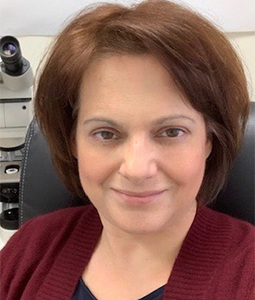
Dr. Ioulia Chatzistamou is a Clinical Professor in the Department of Pathology, Microbiology & Immunology at the Floyd School of Medicine. Her work spans pathology, biomedical research, medical education, and academic leadership. Her doctoral research examined the endocrine regulation of cancer, particularly growth hormone-releasing hormone (GHRH) pathways in gynecologic neoplasms. She completed residency training at Aretaieion University Hospital in Athens, pursued research under Nobel Laureate Dr. Andrew V. Schally at Tulane University, and received additional pathology training at Massachusetts General Hospital/Harvard Medical School. Before joining USC, she served as Lecturer and later Assistant Professor of Histopathology at the University of Athens School of Dentistry, where she was the pathologist in charge of the Oral Pathology Service.
Dr. Chatzistamou serves as Pathology Content Director and directs the Endocrine & Reproductive System Block, the Health Professional Sciences Concentration of the Biomedical Sciences Master’s Program, and the Histopathology Service of the Peromyscus Genetic Stock Center. She developed and directs PATH 711: Experimental Pathology and BMSC 703: Communication Skills for Pre-Health Professionals. She also teaches across medical and graduate courses and facilitates pathology small-group sessions.
Her educational interests include clinical reasoning, self-directed learning, and the thoughtful integration of AI into medical education. A Harvard Macy Institute Scholar with an AI Pathfinder certification from Auburn University, she develops and evaluates curriculum-aligned AI learning tools. Her recent JMIR Medical Education publication,“Curriculum-Aligned Conversational AI to Support Pathology Self-Directed Learning in Preclinical Medical Students: Crossover Randomized Pilot Study” (2026), reported higher faculty-assessed self-directed learning and small-group discussion performance among students using a structured AI coach.
Dr. Chatzistamou serves as the professional-track representative for the Floyd School of Medicine in the USC Faculty Senate and is a member of the Curriculum Committee and Biomedical Graduate Program Committee. Her service includes admissions, LCME working groups, and institutional committees. She mentors medical and graduate students pursuing careers in medicine, research, and other health professions.
Dr. Chatzistamou has authored more than 100 peer-reviewed publications in journals including Science, Nature Aging, Nature Communications, Oncogene, and PNAS. She contributes pathology expertise to research in cancer biology, immune regulation, aging, epigenetics, gut immunology, and Peromyscus-based disease models. Her research has received sustained NIH and NSF support as a co-principal investigator or co-investigator, and she is a co-inventor on U.S. patents. She also serves on editorial boards and reviews manuscripts and grant proposals for journals, NIH, and scientific foundations.
Her scholarship addresses medical education reform, educator wellness, and AI in pathology education and practice. Publications include “Does medical education require radical change?” (Journal of Medical Education and Curricular Development, 2024), “Medical Educator Burnout: A Perspective of an Academic Pathologist” (The Pathologist, 2025), “Pathology Education in the Age of Copilots” (The Pathologist, 2026), and “The Most Important AI Skill? Knowing When It’s Wrong” (The Pathologist, 2026).